
Introduction
Most SaaS platforms serve hundreds or thousands of customers using the same core system.
But how does one platform securely handle multiple businesses at the same time?
The answer lies in multi-tenant SaaS architecture.
In 2026, scalable SaaS products are built on this model because it reduces infrastructure cost while maintaining data isolation.
What Is Multi-Tenant SaaS Architecture?
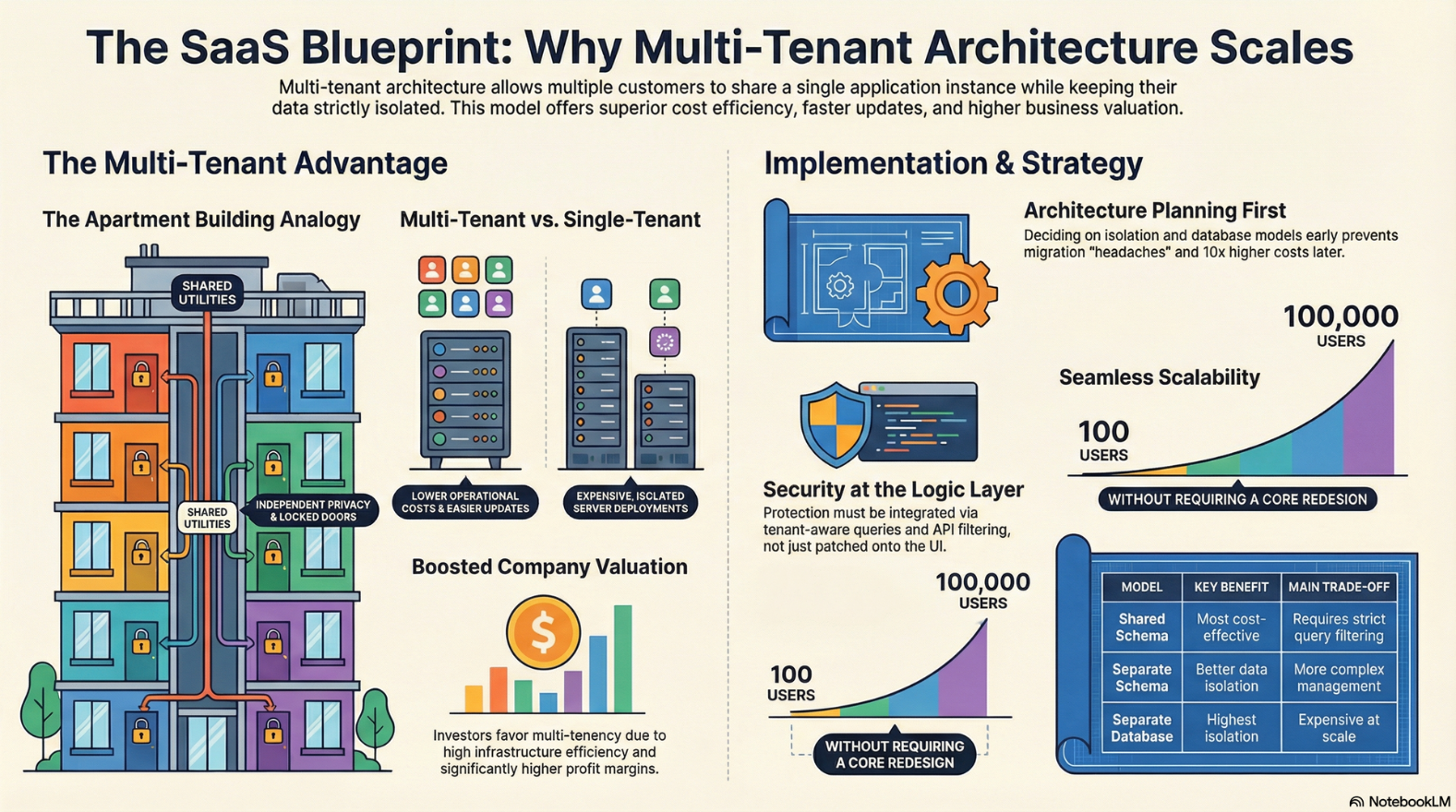
Multi-tenant architecture allows multiple customers (tenants) to use the same application instance while keeping their data isolated.
Think of it like an apartment building:
One building
Separate locked apartments
Shared utilities
Independent privacy
The application logic is shared.
The data is isolated.
Multi-Tenant vs Single-Tenant
Single-Tenant
Each customer has a separate server
Higher cost
More customization
Easier strict compliance
Multi-Tenant
Shared infrastructure
Lower operational cost
Easier updates
Scales efficiently
In 2026, most startups choose multi-tenant models to maximize growth speed and reduce infrastructure expenses.
Database Models in Multi-Tenant Systems
There are three main approaches:
1. Shared Database, Shared Schema
All tenants share tables. Each row includes a tenant ID.
Pros: Cost-effective
Cons: Requires strict query filtering
2. Shared Database, Separate Schema
Each tenant has a separate schema inside the same database.
Pros: Better isolation
Cons: More complex management
3. Separate Database per Tenant
Each customer has a dedicated database.
Pros: Highest isolation
Cons: Expensive at scale
Choosing the wrong model early creates migration headaches later.
Why Multi-Tenant Architecture Increases SaaS Valuation
Investors care about:
Infrastructure efficiency
Update scalability
Maintenance cost
Operational margins
Multi-tenant systems allow:
Faster feature rollouts
Centralized updates
Lower server costs
Higher profit margins
Scalability directly affects company valuation.
Security Considerations
Multi-tenant systems must implement:
Strict tenant ID validation
Role-based access control
Data encryption
Secure API filtering
One data leak can destroy platform credibility.
Security must be integrated at query level, not just UI level.
When NOT to Use Multi-Tenant
Multi-tenant architecture is powerful — but not universal.
Avoid it when:
Clients require strict regulatory isolation
Enterprise contracts demand dedicated servers
Highly customized deployments are needed
Architecture must align with business model.
How BuildMyCEO Designs Multi-Tenant SaaS Systems
At BuildMyCEO, we design multi-tenant SaaS platforms with scalability planning from day one.
Our approach includes:
Tenant-aware backend logic
Secure database structuring
API-level isolation
Cloud auto-scaling setup
Performance monitoring systems
We engineer SaaS platforms that grow without infrastructure chaos.
Conclusion
Multi-tenant SaaS architecture is the backbone of scalable digital platforms.
It reduces cost.
Improves update speed.
Increases operational efficiency.
Boosts valuation.
In 2026, serious SaaS products are built with architectural foresight — not reactive fixes.
