
Introduction
Every SaaS product looks simple on the surface.
Users log in. They see a dashboard. They interact with data.
But behind that clean interface lies a complex system — carefully designed architecture that determines scalability, performance, and long-term success.
In 2026, building a SaaS dashboard is not about UI design.
It’s about architecture.
What Is SaaS Dashboard Architecture?
SaaS dashboard architecture refers to the technical structure that powers:
User authentication
Data processing
API communication
Role-based access control
Real-time analytics
Multi-tenant data isolation
It defines how users interact with the system and how the system handles thousands — sometimes millions — of users simultaneously.
Core Layers of a Scalable SaaS Dashboard
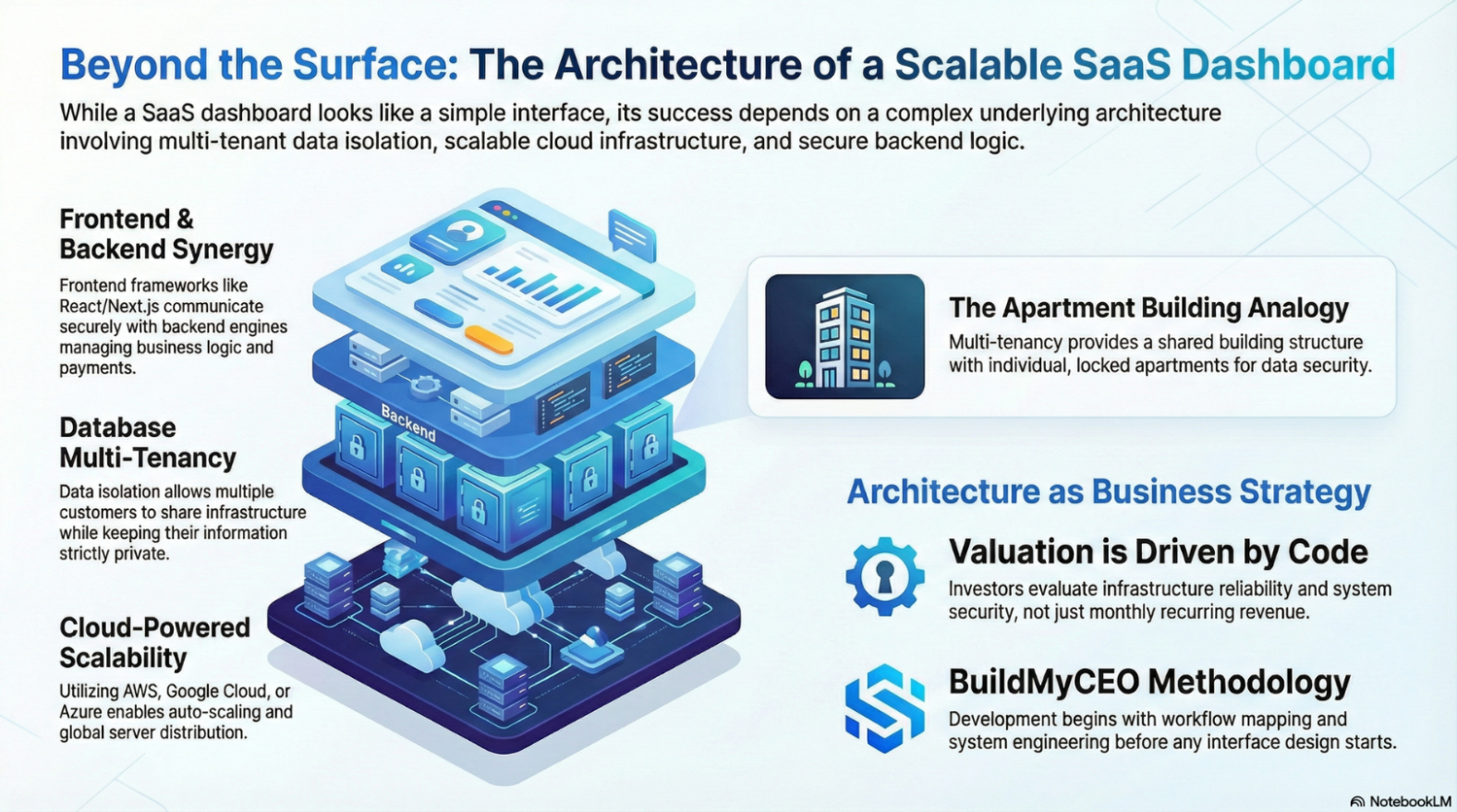
1. Frontend Layer
This is the visible part.
Built using frameworks like React, Vue, or Next.js, it handles:
UI components
Charts & analytics
User interactions
Responsive design
The frontend communicates with backend APIs securely.
2. Backend Layer
This is the engine.
It manages:
Business logic
Authentication
Payment systems
Data validation
Subscription logic
Backend systems must be optimized for performance and security.
3. Database Architecture
One of the most critical decisions.
Most SaaS platforms use:
Shared database (multi-tenant with tenant ID separation)
Dedicated database per tenant (high security model)
Choosing the wrong model early creates scaling problems later.
4. Cloud Infrastructure
Modern SaaS platforms run on cloud services like:
AWS
Google Cloud
Azure
Cloud architecture allows:
Auto-scaling
Load balancing
Global server distribution
High availability
Without proper cloud setup, dashboards slow down as users grow.
What Is a Multi-Tenant SaaS System?
A multi-tenant architecture allows multiple customers to use the same application while keeping their data isolated.
Think of it like an apartment building:
Same building structure
Different locked apartments
This approach reduces cost and increases efficiency — but requires proper security implementation.
Common Mistakes in SaaS Dashboard Development
Designing UI before backend logic
Ignoring scalability planning
Poor database indexing
Weak authentication security
Not planning role-based permissions
Startups often build “demo-level dashboards” instead of scalable systems.
That becomes expensive later.
Why Architecture Determines Valuation
Investors don’t just look at revenue.
They evaluate:
Code scalability
Infrastructure reliability
System security
Performance metrics
A poorly structured SaaS dashboard reduces company valuation.
Architecture is business strategy.
How BuildMyCEO Designs SaaS Dashboards
At BuildMyCEO, dashboard development begins with system architecture planning.
Our process includes:
Workflow mapping
Backend structure planning
Multi-tenant database design
Secure API development
Scalable cloud deployment
Performance optimization
We don’t just design interfaces.
We engineer systems.
Conclusion
A SaaS dashboard is not just a visual interface.
It is the control center of a digital business.
In 2026, scalable architecture separates serious SaaS companies from temporary projects.
If you plan to build a SaaS platform, start with structure — not surface.
